
I remember this one time I was building a small patio in my backyard. I figured I would order just enough concrete for a 10×10 slab, thinking I had nailed the measurements. Turns out, I shorted myself by about half a yard because I forgot to account for that extra bit for waste and uneven ground. Ended up scrambling to mix some bags by hand to fill in the gaps, and let me tell you, that was a sweaty mess. Don’t want you going through that headache, so let’s talk about figuring out how much concrete you really need, whether it’s for a simple walkway or something bigger like a garage floor.
How much concrete do i need?
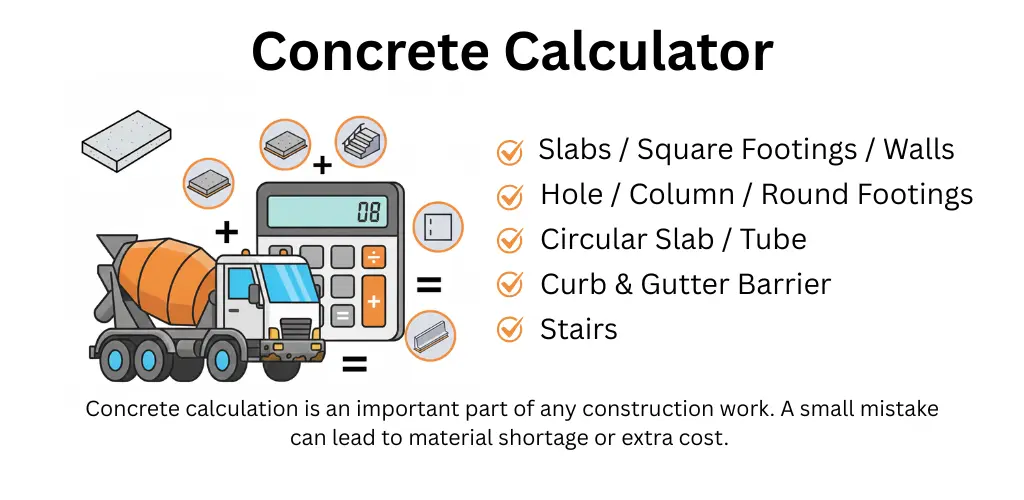
Figuring Out Volume for Project
The key to any concrete calculator is nailing down the volume. Most folks measure in cubic yards since that’s how ready mix trucks deliver it, but if you are going the bag route, we will convert that too. The simple formula for a rectangular slab is length times width times thickness, then divide by 27 to get yards. Thickness matters a ton too thin and it will crack under weight, too thick and you are wasting cash.
Let’s take an example
if you are doing a basic patio, aim for at least 4 inches thick. That gives it enough strength for foot traffic without overdoing it. But if you are parking cars or heavy stuff on it, bump it to 5 or 6 inches. Always add about 10% extra to your calculation for spills, over digging, or just in case better to have a bit left over than run short mid-pour.
How many yards of concrete for a 10X10 slab?
Say you’re pouring a 10-foot by 10-foot slab at 4 inches thick. First, convert everything to feet: thickness is 4/12 = 0.33 feet. So, 10 x 10 x 0.33 = 33 cubic feet. Divide by 27, and you get about 1.22 cubic yards. Round up to 1.5 yards with that extra buffer. If you’re using bags, an 80 pound bag covers about 0.022 cubic yards, so you’d need around 68 bags. That’s a workout if you’re mixing by hand!
Calculating for Different Shapes
Not everything is a perfect square. I’ve done slabs for fences, sheds, even a weird L shaped walkway once. Break it down into sections if it is not straightforward.
Slabs and Patios
These are the most common. Use the rectangle formula above. For a bigger one, like how much concrete do I need for a 30×30 slab at 4 inches thick? That’s 30 x 30 x 0.33 = 297 cubic feet, or about 11 cubic yards. At 6 inches (0.5 feet), it’s 450 cubic feet or 16.67 yards. Folks often ask about that size for garages – add rebar if it’s taking vehicles.
Footings and Foundations
For walls or posts, it’s length x width x depth again, but footings are deeper. A typical footing might be 2 feet wide, 1 foot deep, and as long as your wall. So for a 20 foot wall, that’s 20 x 2 x 1 = 40 cubic feet, or 1.48 yards. Double-check local codes; they might require specific depths to beat frost lines.
Walls and Columns
Walls: height x length x thickness. A 4-foot high, 10-foot long wall at 8 inches thick (0.67 feet) is 4 x 10 x 0.67 = 26.8 cubic feet, about 1 yard. Columns are like mini walls—pi r squared times height for round ones. A 12-inch diameter (0.5-foot radius) column 8 feet high: 3.14 x 0.25 x 8 = 6.28 cubic feet, or 0.23 yards.
Steps and Curbs
Steps: Treat each as a rectangle. For three 4-foot wide steps, each 6 inches high and 12 inches deep: 3 x (4 x 1 x 0.5) = 6 cubic feet, 0.22 yards. Curbs: length x height x width. A 20-foot curb, 6 inches high, 8 inches wide: 20 x 0.5 x 0.67 = 6.7 cubic feet, 0.25 yards.
Post Holes
Simple cylinders. For a 4-inch diameter hole 2 feet deep: 3.14 x (0.167)^2 x 2 = 0.175 cubic feet per hole. For 10 fence posts, that’s 1.75 cubic feet, or 0.065 yards – about three 80-pound bags.
Converting to Yards or Bags
Ready mix comes in yards; one yard covers 81 square feet at 4 inches thick. Bags are handy for small jobs. An 80-pound bag makes about 0.6 cubic feet, so 45 bags equal a yard. A 60-pound bag is 0.45 cubic feet, needing 60 per yard. Quick math: total cubic feet divided by bag yield. And yeah, concrete weighs around 4,000 pounds per yard – heavy stuff, so plan your delivery.
Ready Mix vs. Bagged Concrete
Ready-mix is king for big pours consistent, no mixing hassle, but you gotta use it quick. Costs around $166 per yard in 2025, plus delivery. Bagged is great for small stuff like post holes or repairs easier to store, but pricier per volume and a pain to mix if you need a lot.
Common Mistakes to Avoid
I have seen folks forget the base pour straight on dirt and wonder why it cracks. Always compact a gravel base, like 4-6 inches of crushed stone, to drain water and prevent settling. No vapor barrier? Moisture wicks up, messing with finishes. And measure twice underestimating means emergency runs to the store. Over order slightly instead.
Rebar? For a 4-inch slab, not always needed if it’s just walking paths, but add on an 18-inch grid for driveways. For that 30×30, maybe 1200 feet of rebar. And don’t pour in extremes best in spring or fall, 50-75F, not too late in the day if hot.
Ordering and Mixing Tips
When ordering ready mix, like with accelerators for cold weather or retarders for hot. Know the 10-20-30-40 rule for mixes: 10% cement, 20% water/air, 30% sand, 40% gravel for solid stuff. Mixing bags? Use a wheelbarrow or mixer add water gradually to avoid soup.
Why Curing Matters
After pouring, don’t rush. A 4-inch slab is walkable in 24-48 hours, but full cure takes 28 days. Keep it moist with blankets or sprays to prevent cracks curing builds strength. It dries in about that time too, but test moisture if adding flooring.
Basic Cost Estimates
Figure $110-180 per yard for concrete, average $166 in 2025. For a 30×30 at 4 inches, that’s about $1,800-3,000 just for material. Add labor if hiring, around $5-10 per square foot. Bags run $5-7 each, so smaller jobs stay cheap.
Concrete Calculator App Free Download
If you are tired of guessing how much concrete you will need and want to avoid running short or overpaying for extras, there’s a handy app that makes estimating super easy. It lets you calculate exactly what your project requires, with a bit of buffer built in so you don’t have to stress about shortages or waste.
This app is available on both the Google Play Store and the App Store. You can download it using the links below:


FAQ’s
What is the 10/20/30/40 rule when making concrete?
It is a volume mix: 10% cement, 20% water/air, 30% sand, 40% gravel for basic strength.
How do you calculate how much concrete you need?
Length x width x thickness (in feet) / 27 = yards.
How much does it cost to have a 20×20 concrete slab poured?
About 2.96 yards at 4 inches, so $325-535 material, plus labor.
How many yards of concrete for a 30×30 slab 4 inches thick?
11 yards.
Do you need rebar for a 4-inch slab?
Not always for light use, but yes for driveways.
How much should a 30×30 concrete slab cost?
$1,800-3,000 material.
How far will a truck load of concrete go 6 inches thick?
10 yards covers about 54 square feet.
What is the best base for a concrete slab?
4-6 inches compacted gravel like stone.
What is the best time of year to pour a slab?
Spring or fall, mild temps.
How late is too late to pour concrete?
Avoid freezing or extreme heat, early morning in summer.
What is the 90 minute rule for concrete?
Discharge within 90 minutes, but flexible now.
How much does 3 yards of concrete cover at 4 inches thick?
243 square feet.
Should I use rebar in my concrete?
Yes for tension strength.
How much to pour a 4 inch concrete slab?
Varies by size, but $110-180/yard.
How much concrete do I need for a 20×20 slab 4 inches thick?
2.96 yards.
How many yards of concrete do I need for a 24×24 x4 slab?
7.11 yards.
How long does a 4-inch concrete slab take to dry?
28 days to cure.
How much does a 20×20 slab of concrete cost?
$325-535 material.